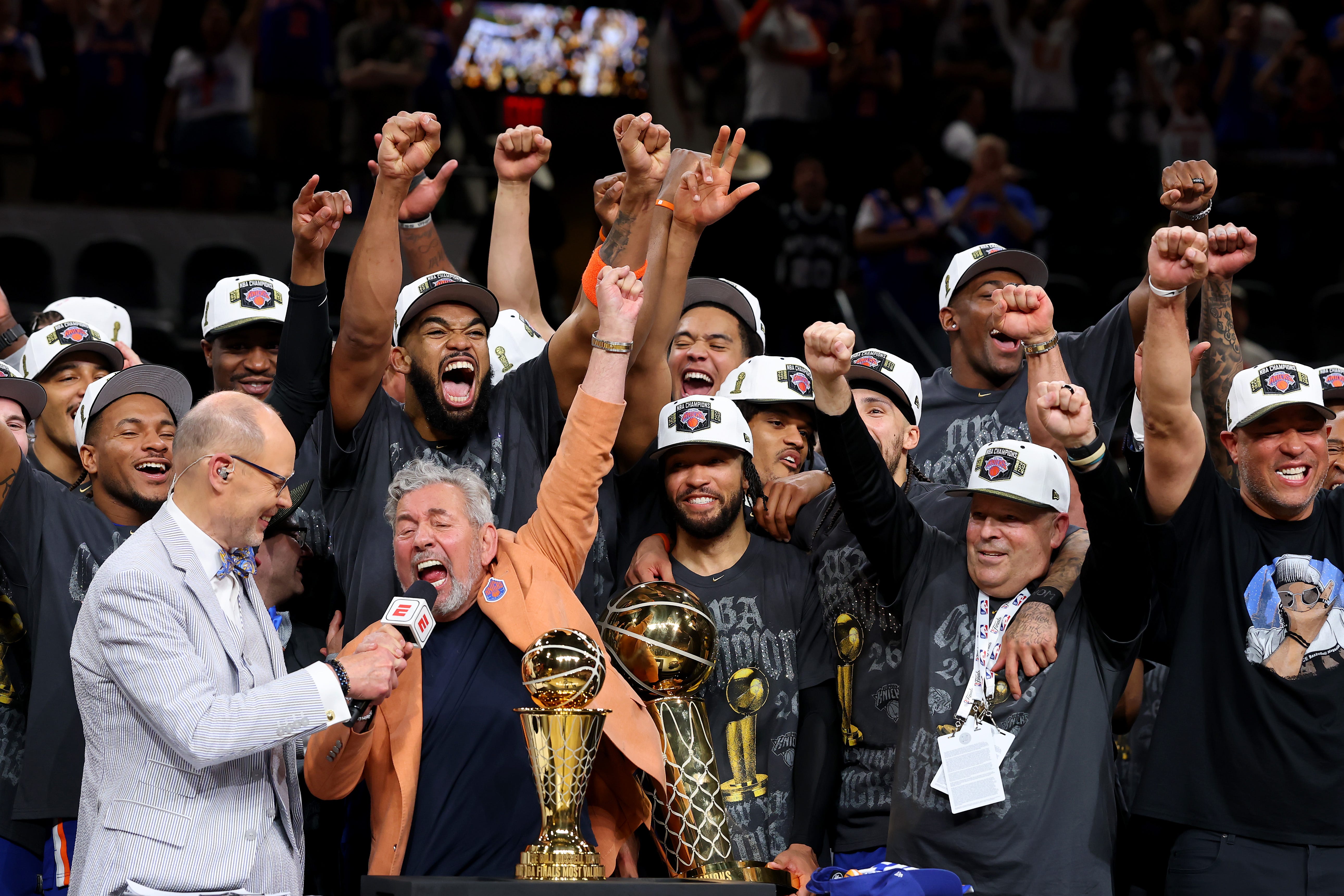
Way more than a Brunson story
Defense still wins championships
This New York story is being told like it’s Marvel, with Jalen Brunson as the superhero who saved Gotham. Vince Carter and Tracy McGrady had a conversation about Brunson as “the greatest Knick.” FOX had a conversation they call “All Hail King Brunson” with with talk about next year’s MVP.
Hero stories are fun; everyone loves Jalen Brunson. But that’s not this story; that’s not how the Knicks won.
Brunson’s superpower is not that he cooks every defense, as that narrative suggests. Through the playoffs on TrueHoop we’ve discussed Brunson’s elite problem solving capability.
But I suspect his most incredible quality may be something else: that he’s the most incredible leader and teammate, which inspires greatness from his teammates, especially—it shows up dramatically in the evidence—when it matters most. The Knicks, as a team, are remarkable in how little they rely on one guy.
The story is not that Jalen Brunson is the next Michael Jordan. The story is that the Jalen Brunson Knicks are the most incredibly tight-knit family, and families are overwhelmingly tougher than collections of individuals. The story is that they love each other so much that nobody minds when Brunson dribbles the most and defends the least.
This question in that Instagram post implies that loudmouths in the media got Jalen Brunson wrong at the time the Knicks signed him. They underrated him as a player. And maybe they did … a little.

And then there’s the hard NBA news for tiny scorers who don’t make much impact on defense, and dribble the hell out of the ball. We LOVE those players, as fans. They are David to the league’s Goliaths. They sell sneakers and dreams. Allen Iverson, Steve Nash, Kyrie Irving, Donovan Mitchell, Stephen Curry …
They do the things we love to see, and we revere them for it.
But as I’ve learned over the last quarter century of obsessing about what works to win titles, those players have profound limitations. Becky Hammon is almost exactly right when she says tiny guys don’t lead teams to titles. (LeBron James and Steve Nash just held a similar conversation.) She didn’t say that because she’s a jerk. She said that because she threw her five-six body into it for an entire career, and like almost every undersized star, didn’t win a title.
It’s not a formula for success—and that’s why Stephen Curry’s so special. He’s taller than Jalen Brunson, and a better defender, but also a career 42 percent 3-point shooter (40 percent in the playoffs), which is different from Brunson’s incredible 38.5 percent and 34.7 in the playoffs. When he was Brunson’s age, in 2018, Curry took more than 10 3s a game and made 40 percent of them all playoffs long.
I’m obsessed with how teams win NBA championships. I’ve published several stories about that in the last few weeks.
This year’s Knicks team did something incredible and new. They assembled an astounding number of very good players.
And somehow, as a group, those really good players improved dramatically from the regular season to the playoffs.
That chart tells a lot:
Victor Wembanyama is out of this world.
The Knicks blew every other contender away with how many players improved in the playoffs.
Especially Karl. Anthony. Towns. Who by this measure, contributed far more than Brunson in the playoffs, largely because he was so much more important on defense.
Shai Gilgeous-Alexander was nowhere near his normal self.
The Cavs, especially Donovan Mitchell, fell off a cliff.
The Spurs, Nuggets, and Thunder each feature a star who is, by every common measure, better than Brunson. Often that’s enough to win a series. But the champs had more “very good” players, and, vitally, they somehow improved in the playoffs. It was decisive.
Of course the Knicks rely heavily on Brunson on offense. Look how they pass the ball: they pretty much pass the ball to Brunson.
What they get out of that is an offense where they drive it a lot, turn it over very little, seldom cause offensive fouls, score well, and hit free throws at an elite rate. They had the playoffs’ best offense, all in all. That’s Jalen Brunson stuff. He is never out of control and makes great reads.
He’s an excellent shooter, but it’s not really about pure buckets: Brunson finished the playoffs as the postseason’s 46th-best 3-point shooter, and sixth-best on his team.
The league’s three serious contenders, the Knicks, Spurs, and Thunder, are also the only three teams that can field five positive playoff defenders.
Meanwhile, by many measures, the Knicks had the playoffs’ best defense. Karl-Anthony Towns, Josh Hart, Jose Alvarado, Mikal Bridges, OG Anunoby, and Landry Shamet gave the Knicks the kind of defensive profile that is necessary to contend. On this playoff run, Towns and Hart were especially incredible.
As was the Knicks’ rebounding. Amazingly, both Towns and Hart grabbed a higher percentage of total available playoff defensive rebounds than Wembanwaya did. The Knicks have a surprising number of players with good steal and block rates. They’re hard to score against, even though by almost any measure Brunson is the worst defender among the team’s regulars.
If you wanted to copy the Knicks, you wouldn’t get very far merely getting a mega-talented scoring guard and good-enough teammates. (There’s a team like that called the Cleveland Cavaliers, who have a star, Donovan Mitchell, that this Knicks front office tried crazy hard to get.) Winning the whole enchilada requires good-to-great performance in all phases of the game, which the Knicks achieved with an ensemble cast that believe in each other in inspiring ways.
Thank you for reading TrueHoop!