Unsung NBA heroes
Non-star stars
I know David Stern wanted the league revolving around stars, but to me that has always missed so much. As a Lakers fan in 1979, a newly minted teenager who watched tape delay games on CBS at 11:30pm et, I knew the story of Magic Johnson and Kareem Abdul-Jabbar could not be written without healthy doses of Jamaal Wilkes (Silk!) and Norm Nixon. For years I tried to shoot like Norm Nixon as I imagined battles against Maurice Cheeks.
I watch a HUGE number of NBA games. 28 this week, plus more than a dozen college and G-League games. And frankly, I notice a lot of elite play from players who don’t make headlines. I want to salute these under-the-radar killers.
Naji Marshall: Second box killer
I talk about the second box a lot, mostly because I work in skill development, and that’s a part of the floor where a lot of players would benefit from adding skill. (And it’s not the same as the mid-range, in part because you’re more weaponized as a passer and driver in the middle of the floor, and referees simply call more fouls in the paint.)
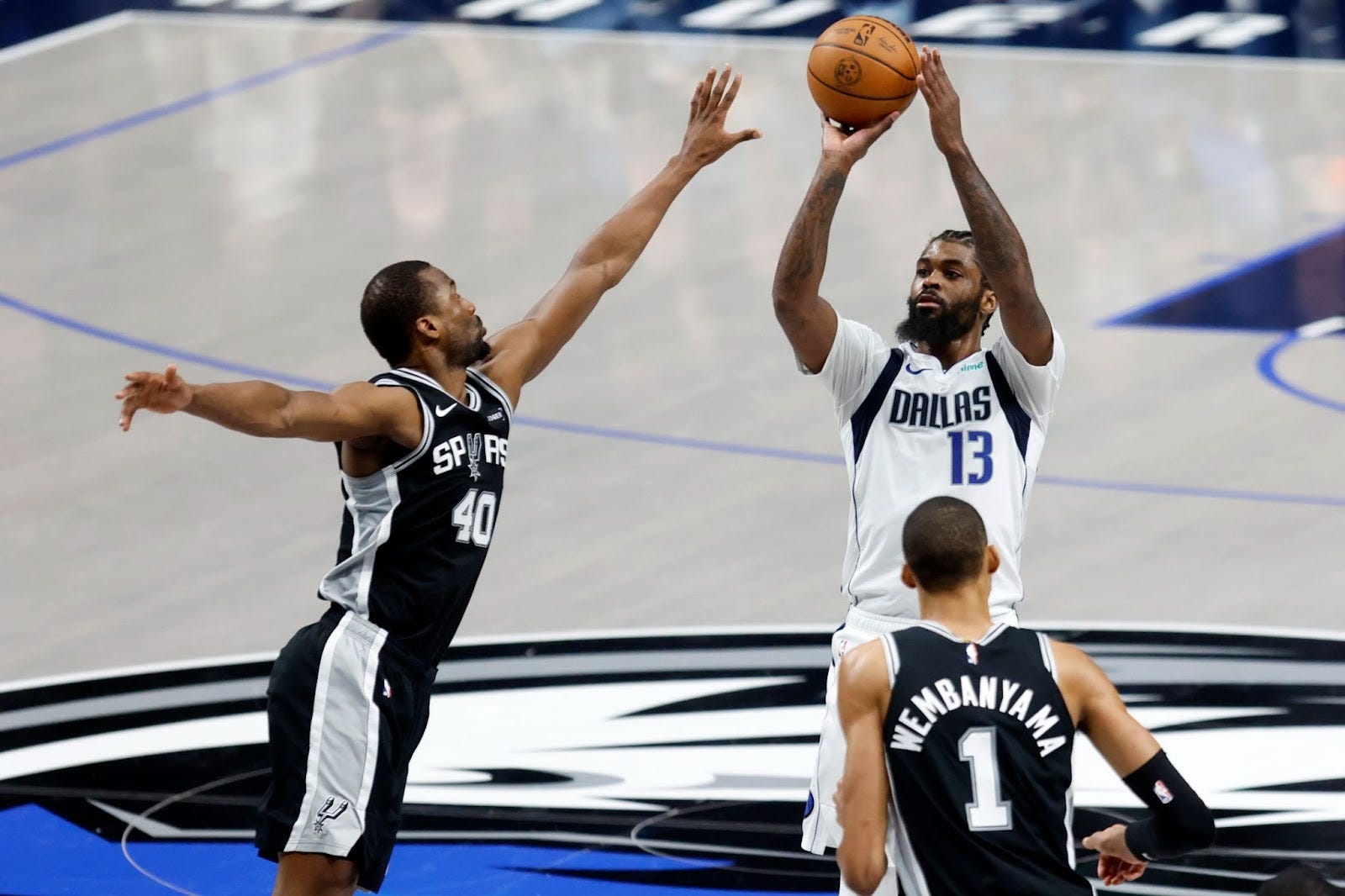
Mavericks’ forward Marshall is a second box killer. I mean, KILLER. As in, he makes over 56 percent of his shots in that area, which puts him in the 98th percentile according to DunksandThrees. His touch is Jokic-like, as in, it’s shocking when he misses even if it’s off one leg and sliding sideways. He’s just a money guy in an area where that’s hard. Jumpers off the bounce, hesi-pulls off the spin, floaters over size. He has a big bag of skill when it comes to paint scoring.
It’s no secret the Mavericks are about to do everything they can to assemble young talent around Cooper Flagg. Marshall is 28, and probably doesn’t fit the profile. He’s under contract next year for a very reasonable $9.4 million. My bet is that a smart team will nab him. Every team can use a skilled scorer like Marshall, he makes teams pay for trying to guard dunks and 3s, exploiting that space in between so well.
Rudy Gobert: Still doing it
There once was a time Rudy Gobert was unquestionably the NBA’s best defender. Now he’s not even clearly the NBA’s best defending Frenchman. And the Wolves have slid away from contending. Gobert isn’t front of mind for most NBA viewers anymore.
But we have missed a lot. Gobert has the second-most rebounds in the NBA this year (behind Karl-Anthony Towns). He’s also top five in total blocks, and the only person to be so high on both lists. He’s getting some chatter about being defensive player of the year for a fifth time, but it’s hard to imagine he’ll get more votes than Victor Wembanyama or Chet Holmgren.
One of the toughest thing NBA big men do is play cat-and-mouse in drop coverage. It’s literally one of the hardest jobs in sports. All at once you must:
Make the driving guard aware that you are present and might block his shot,
Be ready to scramble back to your man to erase any lob dunk attempt,
Have the balance and agility to go get any misses.
Gobert’s footwork on this play is sublime. He hints at a contest to the shooter then easily slides into the blockout/lob defense position, keeps the big off the glass and beats him to the missed shot. The quick outlet pass was a bonus.
One day he won’t be an elite defender, but that day seems far off still.
Derrick Jones Jr.: shot contestor
Forget the misery of the Clippers’ ongoing Kawhi scandal, and just watch Derrick Jones Jr. on defense. According to NBA.com/stats, his man (or the shooter he helps onto) takes just over 10 shots a game, and makes four per game. That 40.2% rate is elite. Jaren Jackson Jr. checks in at 42 percent, Defensive Player of the Year candidate Scottie Barnes’ shooters make 47.9 percent of their overall shots.
Jones is quick and long but that’s not enough, there has to be a desire and a choice to make the effort time and again. Don’t forget how many shots he takes away just because of guarding the ball tightly to begin with. Jones plays 27 minutes a game and fouls, on average, just twice. He is doing it in the best way possible. If the Clippers rebuild, Jones Jr. is ready to help a team trying to improve on defense.
Olivier Maxence-Prosper: shot chart
Today’s offenses want players who can make dunks and 3s. Guys that can score productively and efficiently in those two areas need only to be able to play decent defense to earn rotation minutes. Alas, very few rookies can be good in either place, much less both. The hope is that in a season or two they figure it out.
In the case of Olivier Maxence-Prosper, he just needed consistent playing time. Who knew?
TrueHoop readers did, as we like to say playing time is like oxygen to all players, without it they suffocate. Prosper is but a symbol of what is possible with consistent minutes. The numbers are pretty staggering. According to Dunksandthrees.com, the incredibly large and athletic forward from Montreal makes 73 percent of his shots near the rim, currently in the 91st percentile, and has made 41.4 percent of his 3s, 93rd percentile.
That alone is noteworthy. Just as importantly, 203 of the 215 shots he has taken this season either behind the 3-point line or around the bucket. Great shots in terms of location and, based on his rate of makes, not forced shots either.
This finish, bullying Jrue Holiday before using a smart fake to throw off the timing of Robert Williams III is emblematic. Ask any Grizzlies fan about the one guy who always plays with a ton of energy and you will get a near unanimous answer (I asked Chris Vernon to prove the point and he did). He can shoot and finish too, while being able to defend guards, scoring forwards, and backup centers? Geez, what other bench-ridden player just needs some oxygen to show his talents?
Nickeil Alexander-Walker: free throws
I’m sure it’s fun to be Shai Gilgeous-Alexander’s cousin most of the time. But I’m also sure that Nickeil Alexander-Walker must at times get a little frustrated that his cousin is essentially better than him at everything.
For the moment. This season:
SGA is making 89.5 percent of his free throws
NAW is making 89.2
By my math, Nickeil would surpass SGA’s current percentage by making his next eight in a row. It’s that close.
In almost every mechanical movement, balance is integral to consistentcy. In baseball and golf, swinging bats and clubs is a violent move, but in training sessions it is preached to complete the swing and hold the finish, staying balanced on two feet. I think the same principle applies to shooting in the NBA. It is a very common teaching point to “stay balanced and hold your form until the ball reaches the rim.” NAW looks so good taking his free throws that I sent two dozen NBA and college players this exact clip. (If you look closely you will see him lift his heels up and then go back down, some people think that’s a mistake. I’m not one of them, necessarily. He is so balanced and fluid overall, I would not make any recommendations of a single tweak unless he suddenly started missing.) He won’t end up with the best free throw percentage in the league (Stephen Curry is in the lead now) but SGA is just a miss or two from falling behind his less famous cousin!
Davion Mitchell: Shooting the lights out
After winning a title at Baylor, Mitchell was a lottery pick of the Kings. He was always considered a “pit bull” on defense, short and tough with real quickness, but his shooting was an issue. It remained a problem until his third season in Sacramento, and to his great credit, he has literally gotten better as a shooter every season. 40 percent is an important line in the sand to become an elite shooter. Now in his fifth NBA season and playing for the Heat, Mitchell is making 41 percent of his 3s.
His balance and follow through are clones of what we see in NAW’s free throw stroke, a beautiful thing to watch. There is a slight head push backwards on this shot, it’s not always present, but overall, it’s a shot young players should emulate. His shot chart also shows he’s deadly from the top, which is where you want your point guard to hang out so they can be the first person back on defense.
Kings fans are probably sorry their team let Mitchell get away, but on the other hand I’m not at all sure this player development would have happened had he stayed in Sacramento.
Jalen Suggs: defensive demon
An NBA executive told me last year that he liked Jalen Suggs, but thought he lacked the temperament to lead a contending team. He described Suggs as a “live wire” who is always “hot.” I am not at all comfortable putting a ceiling on the leadership game of a 24-year-old. But I have no problem suggesting he is a big part of the Magic’s surge back into strong playoff contention. Over the last 15 games the Magic lead the NBA in defensive rating, and have climbed back into the top 10 on that side of the court for the season. It’s been their identity for two years now. The whispers of a coaching change at the end of the season continue, but if they keep locking people up, it’d be a shame to see any change on the bench. It’s not any coach’s fault that Paolo Banchero and Franz Wagner struggle to stay healthy or make a 3.
Suggs has been a stellar defender this year, his 3.4 percent steal rate ranks in the top 3 percent on DunksandThrees. His overall impact is top four percent among all players. He’s built like a tall linebacker with power and speed, and he has a disposition to defend everyone at the same time. I love him. His energy and impact helped save the Magic when things were headed south, and with their win over the Cavs Wednesday night they sit eight games over .500 for the first time this season. They are a mere three games behind the third-seeded Knicks in the loss column, two behind the fourth seeded Cavs. Suggs is a big part of that story, while Paolo and his coach have exchanged barbs, Suggs has led by example and heart.
Scottie Barnes: the Derrick White of forwards
Take a look at the top shot blockers and you will see a bunch of 6-10 or taller men … and Derrick White. He might be the best guard ever at blocking and contesting shots.
So it’s worth noting that Scottie Barnes is only two or three inches taller, and blocks even more shots than White. His feel for the game is Mozart special, as in, it seems like he was born to play hoops. This play is such a perfect example of what I mean–first he gets a second box touch, draws two defenders, then makes the easy kick out pass (he so often makes the perfect and simple play). Barnes goes to get the missed shot (another area he excels in), catches a stray hand to the face, then heads back the other way. He isn’t racing, or jogging, just in the flow of traffic, when wouldn’t you know, he is in the perfect place to swat this shot out of bounds. If he runs too fast or too slow this doesn’t happen.
Sometimes he does race. He does what’s needed so often, flitting from spot to spot and shooter to shooter. As a forward, with guard skills, this is rare. One All-Star told me he thought Barnes played harder game to game than any other star. It shows in his shot blocking metrics, 89th percentile amongst all players. He’s in the 94th percentile in DEPM, and seems a lock to make many all-defense teams.
Thank you for reading TrueHoop!