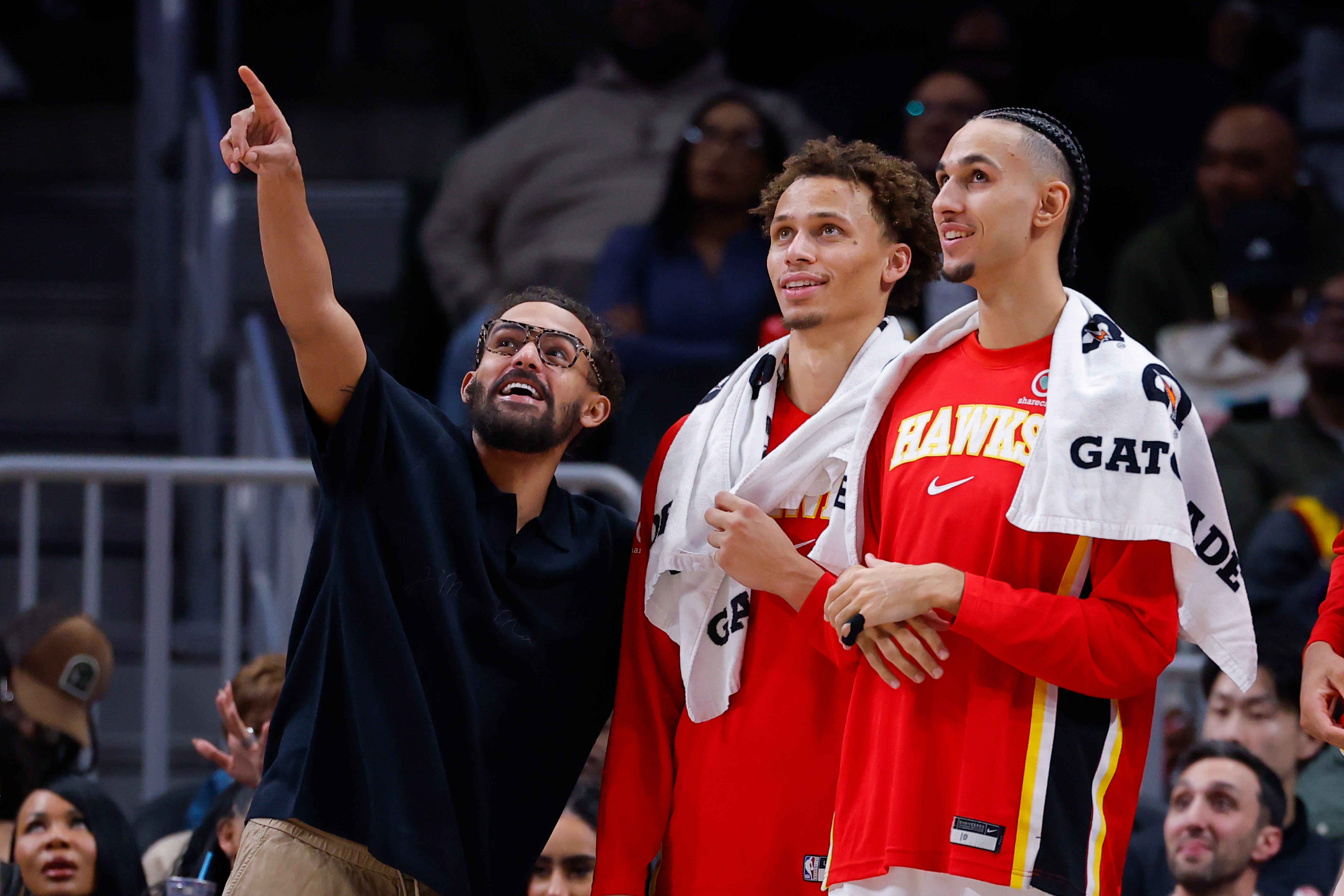
Trae Young, salary dump?
Once traded for Luka, now a cellar-dwelling Wizard

The free agent market went so frigid last summer that Gary Trent Jr. signed with the Milwaukee Bucks for $3.7 million. He’s a solid NBA player who earlier had, reportedly, turned down a 2024 offer worth $15 million a year because it wasn’t enough. In the interim, he didn’t change much, but his problem became that whereas most years five or ten teams might have bid for his services, in 2025, pretty much all the teams with meaningful cap space were named the Brooklyn Nets.
Since then, you’ve probably heard a lot of talk about this being the “apron era,” as if the rules governing the highest-spending teams only just appeared. But the basic structure of the current CBA comes from 2011, with the wrinkle of the second apron arriving in 2023. Another way of seeing what happened is that the CBA is about the same as ever, and the money more than ever, and the salary cap higher than ever, thanks to rising revenues. But we happen to be in a moment when a great many teams are feeling the pinch of wild overspending in the past.
In the years leading up to 2025, NBA teams handed out deals like:
Ja Morant $197 million for five years
Jordan Poole $128 million for four years
Tyler Herro $120 million for four years
LaMelo Ball $203 million for five years
Jalen Green $105 million for three years
I could go on.
Advanced statistics came to the NBA in the second half of Allen Iverson’s career, and immediately began roughing up the idea your team needs a high-volume scorer who don’t make a difference on defense. At their best, they’re highlight machines, and indeed the best teams have players like Tyrese Haliburton, Donovan Mitchell, and Stephen Curry–who appear similar.
Flashy scorers almost always unlock outlandish salaries, but only sometimes contribute to winning.
But the data suggests that there really is no such thing as a poor man’s Stephen Curry. If you’re one of smallest guys out there, and if you’d like to hide on defense, and if some nights you’re going to miss 20 shots … then you can help your team on your best nights, and you’ll make a lot of highlight packages. But you aren’t worth a ton of money, because when you are just a little off, tired, slow, unmotivated, in a funk, or aged you cost the team dearly. And every player endures those things. It’s like riding a motorcycle without a helmet. Most days it’s great, but the bad days hurt more.
Trae Young was once traded for Luka Dončić, who is now a leading MVP candidate. Trae has long been seen as a blue-chip player. When he signed a $215M five-year contract extension in 2021 (it kicked in a year later) it was hard to imagine that the Hawks might ever trade him for the expiring contract of C.J. McCollum.
(McCollum fits the trend. He recently demonstrated that he’s still a fully badass scorer, but times being what they are $30 million is a lot for someone whose defense has never mattered. Celtics fans might also want to discuss Anfernee Simons here.)
Trae Young is among the NBA’s worst defenders. Sixth percentile according to Dunks and Threes, even after rumors of improvement. Trae’s 74th in the NBA in production per minute, but given his limited minutes only around 200th in wins contributed. By that website’s sophisticated measure, Young has contributed 0.9 of a win to the Hawks this season, which is exactly half of the contributions of, say, the Grizzlies’ Cedric Coward.
But Trae Young makes $46 million, the NBA’s 21st highest salary–enough for eight Cedric Cowards, at current prices. It is often like this for big-name scorers.
The problem isn’t Trae Young, exactly. In the past, teams with overpaid alpha scorers just accepted that they came at a premium. The problem is that the whole NBA spent in such a way in the past that now front offices are rightly being directed to cut the fat. And if you’re trying to muscle your way into more wins, the fat looks like Trae Young.
Thank you for reading TrueHoop!


Same GM traded for him both times. I know that teams have a floor that they have to spend, so perhaps this mitigates that obligation for the Wiz. It will be very interesting to see what Trea's future is like contractually year after next.
Good to hear from you.
All of this makes perfect sense. BUT, there are two things that are making my mind boggle about it anyway:
1) HOW do the Hawks not get ANY draft capital at all? Was Joe Dumars secretly helping out with this deal? Even Trader Troy would have gotten at least 2 2032 2nd rounders.
2) Sure, winning attracts fans, but so do highlights, and getting fans buzzing, getting them excited, getting MSG to chant words at you that I shouldn't type here, is something that players like Trae Young can do. That's ALSO quite valuable, but who's measuring that stat, and I don't just mean the "vibe check," or "Q Score."