
The 94 percent failure rate of the NBA draft
A tiny handful of players succeed for their first team

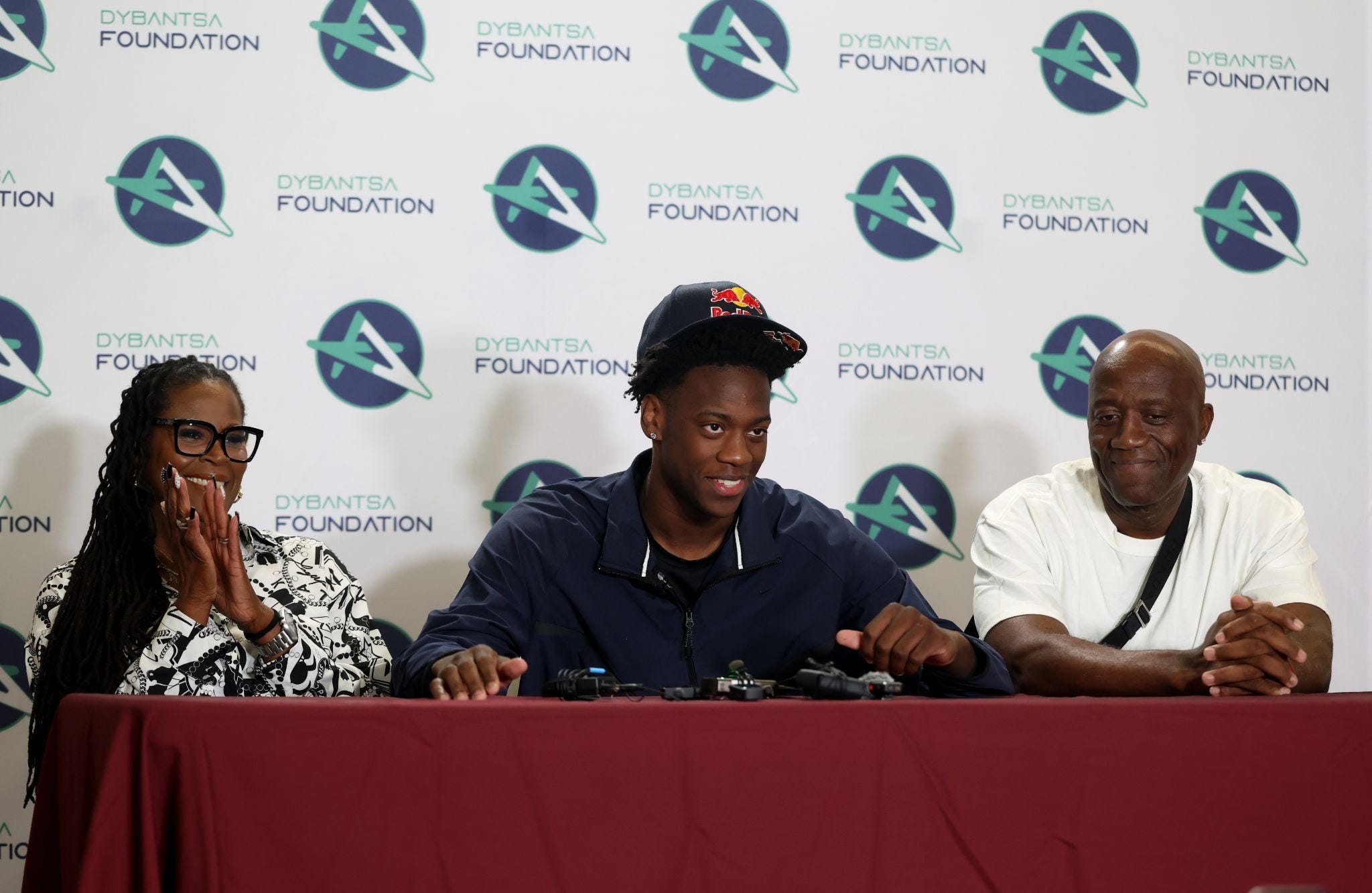
The draft lottery was Mother’s day, the draft is a tad under six weeks out, kicking off Tuesday, June 23.
Which means for most of us, it’s time to imagine how much better our team is about to become. You get some carefully researched prospect, they mature into something special, and next thing you know your team is meaningfully better.
But here at TrueHoop, we just crunched decades of numbers, and discovered that the likelihood any team will draft a player, and have that player become an excellent NBA performer while still in the same uniform, is six percent.
In other words, 94 percent of the picks in June’s draft are likely not to make your dreams come true, either because:
They’re not good enough, injured, under-nurtured, or similar;
Or by the time they’re highly productive, they’ve moved on to another team.
We used Dunks and Threes data to assess that, and we set the bar high: at ten earned wins a season. That’s precisely where Kon Knueppel finished his rookie year. (It’s also about half of the production of a typical season’s best; this season, Shai Gilgeous-Alexander finished just below 20 Earned Wins.) But my guess is, it doesn’t much matter which numbers you use; you’d find similar results from almost any robust analysis.
Take 2019. We go whole decades without prospects as certain as Zion Williamson. Here’s what ESPN’s Jonathan Givony wrote at the time, in the Year of Zion:
We’ve never seen a prospect quite like him in terms of his combination of productivity, athleticism, competitiveness, skill and feel for the game -- not to mention the sheer star power he’ll bring.
The big question now is how New Orleans will build around Williamson moving forward. Jrue Holiday, Lonzo Ball, Brandon Ingram and Josh Hart make up a strong group …
It’s a hard job, this predicting the future.
Jrue did his winning elsewhere. Lonzo got badly hurt and was recently waived by the Jazz. The Pelicans traded Ingram to Toronto to save money, and Josh Hart is on TV as the little engine that could drive the Knicks to the Finals.
Star power has not been Zion’s forte. Nor has productivity. This season, in Dunks and Threes, Shai Gilgeous-Alexander accounts for almost 20 Thunder wins. Owing to injuries and team turmoil, Zion has accounted for 31.3 wins … total. Over the seven years since he was picked first overall. These kinds of setbacks are common.
This is the nature of the draft. We assume, this time of year, that those picks are additive, like a birthday present. Is your team kinda bad? The A.J. Dybantsa fairy will make your troubles go away!
But of course, bad teams are often full of last-year Dybantsas. (2024 top overall pick Zaccharie Risacher barely got on the floor for the Hawks in the playoffs.) A lot of teams have problems that one more prospect can’t fix.
The Wizards, run by Sam Presti’s former assistant general manager Michael Winger, are three years into playing the numbers game of collecting young prospects. Do you know what Alex Sarr, Bilal Coulibaly, Tre Johnson, Cam Whitmore, Bub Carrington, Will Riley, and Kyshawn George have in common? Not one of those players is yet 23 years old. That’s the good news.
But those players have something else in common: they’re not good. Not yet. Coulibaly has been steadily improving, Sarr is in the 69th percentile for his age on Dunks and Threes, Tristan Vukcevic and Kyshawn George are progressing. But in Estimated Plus-Minus, Bub Carrington, Will Riley, Cam Whitmore, Tre Johnson, and Julian Reese are all in the bottom quarter of like-aged NBA players. Even worse: Whitmore was OK in Houston, with seasons of -0.9 and -0.5 in EPM. Then he came to the Wizards and dropped to -3.6.
Stephen A. Smith just called the Wizards a “basketball abomination” and you probably noticed projected top overall pick A.J. Dybantsa looked a little queasy when he watched the Wizards win the lottery.
But in mock draft land … things feel better! “If they just take Dybantsa and make him the driving force of an already long, athletic, and versatile roster, they’ll instantly become one of the most interesting young teams in the league,” writes J. Kyle Mann on the Ringer’s mock. ESPN’s Jeremy Woo writes “this is a shot in the arm for Washington, which has an opportunity to add a franchise-level prospect.”
The essential invitation of a mock draft, or of the draft generally, is to permit you to imagine a young player joining your team, and then blossoming to become a major contributor as your team improves. That fairy tale underpins almost every line of every mock draft.
This is a story about why that almost never happens, and what we can do about it.
For a typical mock draft projection to be right, and for a player to blossom on the team that drafts him, many things have to go right.
The pick has to be as projected. Just for fun I looked back at four mock drafts from 2019. Between Jonathan Givony, Sam Vecenie, Kevin O’Connor, and Sam Smith, they got 23 percent of the first-round right. The very best nailed nine out of 30.
Players are essentially never good enough to succeed in the NBA when they arrive, so off-court player development is critical. David Thorpe will tell us next week how exceptionally rare that is outside of Oklahoma City and San Antonio.
The team has to give the player minutes and opportunities.
The team has to use a strategy that lets that player succeed. Karl-Anthony Towns on the Wolves was too expensive. Playing from the pinch post in New York he’s arguably the MVP of the postseason.
The player has to remain healthy, which is not merely a matter of luck.
By my count, only 23 players out of the 60 players drafted in 2019 are still active in the NBA, which means mock drafts are missing the important note that “this guy probably won’t stick.”
Here’s what new Mavericks GM Mike Schmitz wrote about Jarrett Culver going into the 2019 NBA draft:
