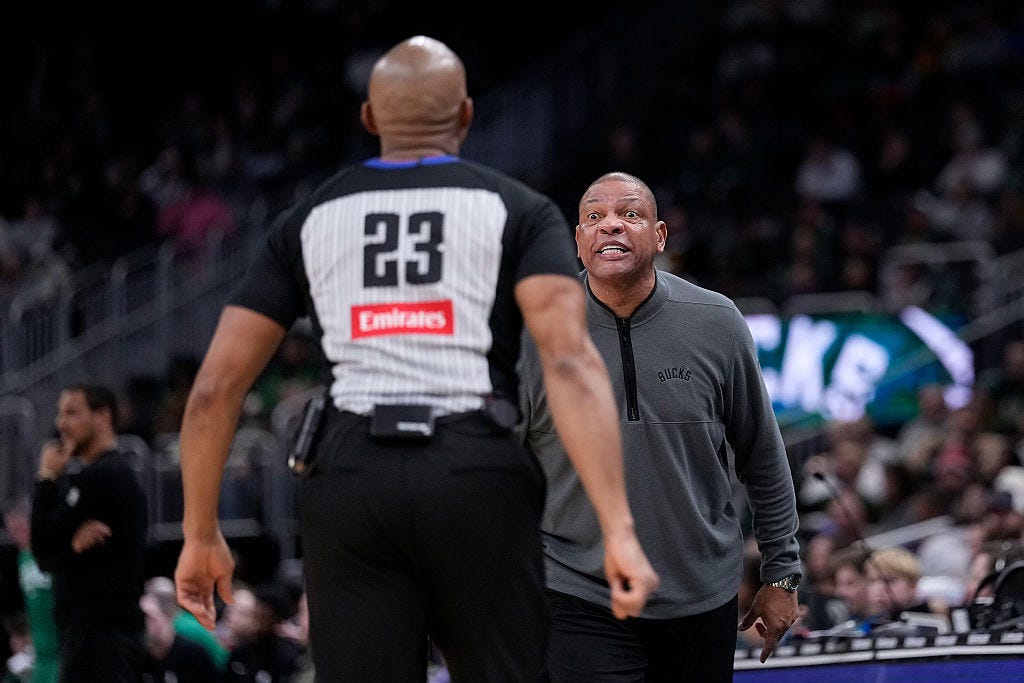
Screw your coach’s challenge
The league has other ideas

Yesterday we dug deep into the data to discuss how best to use coach’s challenges in NBA games. Which kinds of calls, which parts of the game … what it takes to succeed with more than 80 percent of your challenges like the Knicks, instead of less than 30 percent of the time like the Spurs (who somehow have only had five successful challenges all season).
Today the mission is different: to explain why coach’s challenges were never the right solution.
Slow-motion replay can warp your brain into thinking NBA refereeing is easy. But stand on the baseline as Giannis crashes through the defense, with one real-time angle in lousy human eyes and … refereeing is hard as hell. Owing to the fact players get faster every year, it’s harder than ever. No human could ever call a game perfectly; that’s a job for a cyborg with a thousand eyes and a supercomputer brain. And nobody likes the idea of cyborg referees.
When I was a kid the blown calls came out in the wash. You screamed bloody murder at the referee for one timeout at the longest, and then you just worried about the next thing. Later it emerged that referees from that era did all kinds of shady things, from evading taxes en masse to “managing the game” which meant making up for one bad call with another. (Or there was Joey Crawford who just did not have a judicial temperament at all.) But I would argue that mostly that system worked well enough. Normal fans generally felt that the game was on the up and up. The whole thing was flawed and human, and that’s true at the basketball game, at the school dance, merging on the freeway, and everywhere. We were inside the margins of acceptable failures.
The digital age changed things. Technologies emerged—HD broadcasts, rewindable DVRs, iphones from the sideline, YouTube—to make it easy and obvious to see the screwups. Just as more games ended with livid fans taking to the internet, NBA referee Tim Donaghy made headlines for being dirty as hell. In 2008, the nightly screwups we’d always had combined with the very real presence of the mob, and now pervasive gambling, to kick up a dust devil of suspicion. It grew easy to imagine every refereeing mistake fit some sordid scheme.
The league office made many changes in the aftermath of the Donaghy scandal. The most important one may well be that they spent untold millions on what they romantically named the Secaucus Replay Center.
It’s like the gamemakers’ back room in the Hunger Games. They can see everything—what we get at home is a tiny dumb sliver of what they see in Secaucus. Did you know that every NBA arena has cameras that are built into the arena and not part of the broadcast? The league VP who oversaw technology, Steve Hellmuth, told me that at the time he believed they had (he used fancier, more specific terminology) the world’s fastest and biggest connection to the internet, to feed live video from every possible angle. It’s not just that they have all this video piping in, but also that it only takes half a second to swoop around and see whatever you want. I stood there as it took maybe a half second to zoom deeply closely to see if Stephen Curry’s toes were behind the 3-point line or not.
At that time, I wrote about the NBA rulebook like it was my beat, and got the rules changed about traveling in 2009, and as part of a bigger TrueHoop team, pressured the league to ban flopping in 2012. The Secaucus tour they gave me in 2014 came after years of my writing that the league had a big fat problem: fans at home knew from slow-motion HD exactly what had happened, but the referees in the stadium with the whistles had no idea.
The people in Secaucus had built a tool to solve that problem and shut me up. The room had a dedicated staffer watching every game live, with roughly one zillion screens, all overseen by a referee supervisor. Every tricky call got close attention within seconds. It was majestic, as far as accurate knowledge went.
A lot of NBA issues go like this though: at the top of the league offices, they know everything. But there’s always some structural or political reason why they have to do dumb stuff anyway. In this case: it would take rule changes for knowledge to flow from Secaucus to the court where it could actually make calls more accurate.
The NBA has a competition committee that weighs rule changes. And other than very limited instances of sideline video reviews, as it was explained to me over the following years, the league simply couldn’t talk the competition committee into modernization. The committee at the time was Rick Carlisle, Doc Rivers, Monty Williams, Joe Lacob, Sam Presti, Mitch Kupchack, Roger Mason Jr., Nick Arison, and Masai Ujiri. A league official who sat in those meetings complained to me that almost no one would vote with anything in mind other than helping their team win a few more games in the short term. If you have a star who uses a rip-through move to get to the line, you use the committee to keep that trick legal. If you play tenacious team defense, you try to legalize more contact. No one seemed to care at all about the health of the game, YouTube, DVRs, nor the relationship between fans and the league. No one on the committee, the official told me, seemed to care about getting the calls right.

In 2014, that official told me, almost with a smirk (the feeling I got was how dumb is this?) that it seemed like the only thing the committee might vote for was checking with Secaucus when coaches wanted to. A coach’s challenge, like from football. The whole idea had nothing to do with improving the game, and everything to do with giving coaches more power. The league would dissect every call in real time, and at times even got that referee supervisor to weigh in on the national TV broadcast. But they couldn’t easily get the correct call into the game. On the court, players and referees could petition only god, or a head coach, if they wanted that accuracy to affect who wins and loses.
Back then, the league thought the coach’s challenge didn’t fit their needs, pushed the competition committee for more, and instead got nothing. Embarrassing examples of human error on the court piled up in slow motion. I’ll never forget when Kevin Durant took three complete steps out of bounds before saving the ball to Stephen Curry who hit what looked like it might have been a game-winning shot in January 2019. (James Harden ended up winning the game for the Rockets, thankfully.) ESPN made a studio segment about it with Rachel Nichols, Amin Elhassan, and Scottie Pippen blown away at the league’s incompetence. Pippen suggested the referees were Warriors fans. Five years into the replay center existing, and unable to address glaring problems like that, the league relented and instituted coaches’ challenges as a puny first step in making calls more accurate.
When they launched coach’s challenges in the fall of 2019, just about everyone hated it. Gregg Popovich said he didn’t use it because he didn’t understand it. LeBron James said that referees would never overturn certain calls because they can’t stand to be wrong.
To this day, to me, it feels like a high-school theater production. Moments after play stops, the referee supervisor in Secaucus knows the correct call. But instead of getting on with that insight, we have a clown show to put on:
Assistant coaches scour the video and giving a hand signal,
The coach calls the timeout,
THE GREEN LIGHT signifies the challenge,
The referees sidle over to the replay monitor,
The broadcasters mount consternation,
Headsets are donned where,
We watch TV of people watching TV as the referees watch an incredibly poor facsimile of the replay center, usually two or three grainy angles on a tiny screen courtside.
As far as I can deduce, all of that theater serves only one purpose: to keep people from feeling like Big Brother is in charge. They made a promotional video about the replay center and were careful to lead with “as in the past, game officials will continue to make the final decision on all reviewable calls.”
The very next thing in the video is NBA VP of referees Joe Borgia saying “the ball changed direction, it definitely hit his heel.” On the screen we see Heat guard Toney Douglas in a defensive crouch, as a bounce pass from the Nets’ Jorge Gutiérrez glances off Douglas’s right foot. “That would be perfect to show the referee,” says Borgia.
Borgia, at that time the lord of hiring, promotions, and playoff assignments among NBA officials, says the ball definitely hit Toney’s heel. This set up seems to be designed for Secaucus to make the decision. (It’s a plucky damn on-court official who’d get on a headset with Borgia, watch a small amount of crappier video, and rule it didn’t hit Toney’s heel.) Then it’s Borgia who gets on the mic to talk to the referees courtside. That’s how it goes. What percentage of review decisions, since 2019, do you think have come from Secaucus? I’d bet a ton. The charade is that the decisions were ever being made in front of you.
But this month, the league kicked off phase two of this season’s plan, where referees wear earpieces in game, and can communicate in real time with each other and Secaucus. More than a decade after they built it, the replay center will have pipes into the live game for the first time. The October press release says “During the second phase, referees will be able to communicate directly with the Replay Center and each other during at all times during the game. The second phase will run through at least the NBA All-Star break in February.”
And so now, for the first time, Secaucus will have the right to reach the referees “during at all times!” This is how you get no one to notice a massive new policy shift. Phase one is barely worth mentioning because it’s so menial, phase two is maybe only a matter of weeks. And so, we’re halfway to cyborg referees.
The league has waited and schemed 12 years to build a pipe from Secaucus to the court. The calls will be more accurate, but less and less will they be made by the actors in the gray shirts on the court. And the conspiracy theorists will declare it’s all being rigged from New Jersey.
It also means the writing may be on the wall for the coach’s challenge. If the point of that challenge is to check with the replay center, now it’s something that happens constantly. How long can the coach’s challenge even last?
But there’s one more wrinkle to this story: referees aren’t wearing earpieces. Not to my eyes anyway. Join me in scouring this collection of recent high-res still images of referees at work. Those are naked ears, right? When the policy was announced in the fall, January was to kick off phase two. Where is phase two?
Thank you for reading TrueHoop!