
Everybody loses
A conversation about sports gambling with author Danny Funt

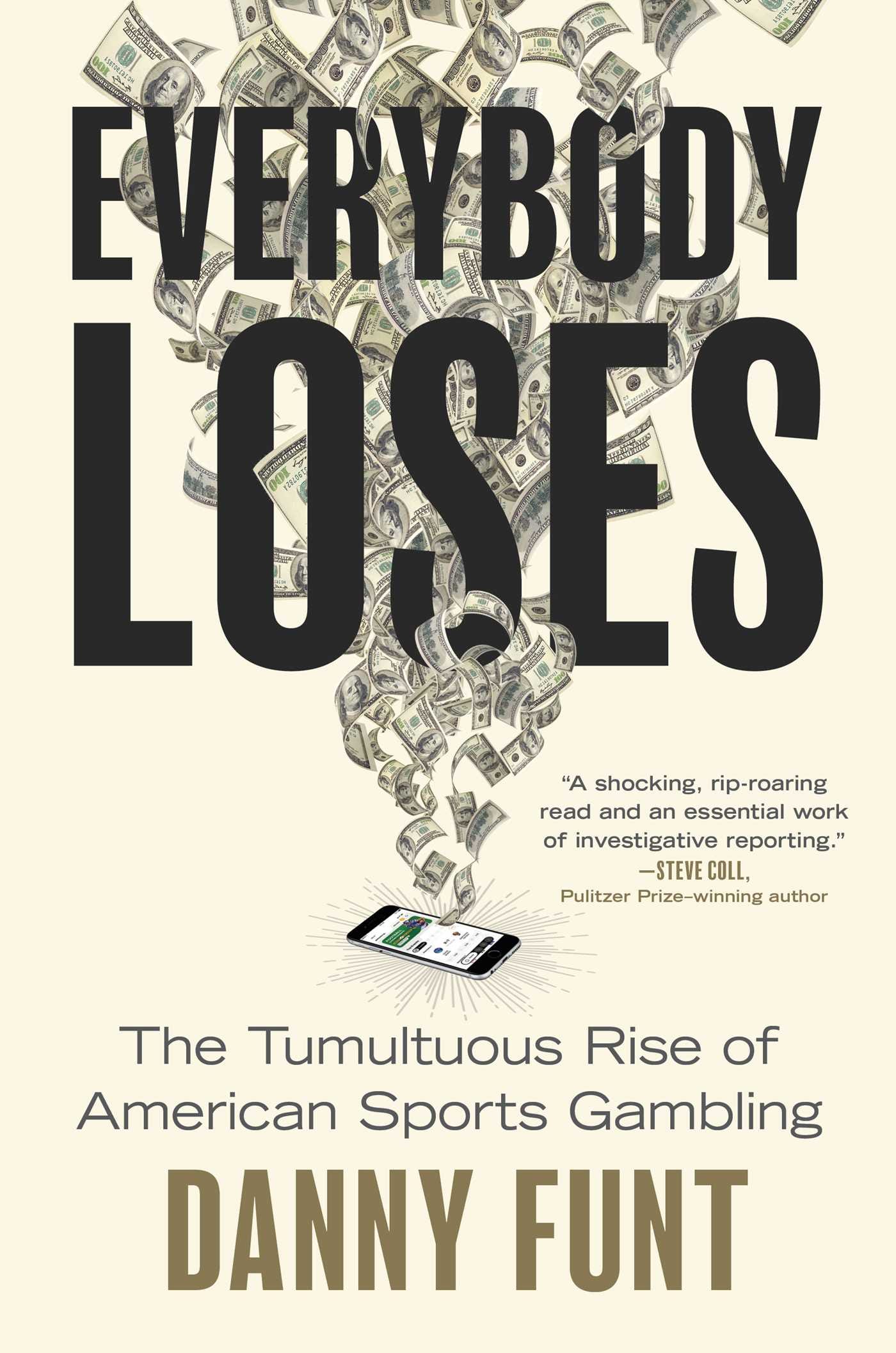
Danny Funt is a wonderful writer whose work has appeared in the Washington Post, The New Yorker, The Wall Street Journal, and the Columbia Journalism Review. Some time ago he called me up to ask about TrueHoop’s choice to decline advertising dollars from the sports gambling industry. That was part of his exhaustive research for his wonderful new book Everybody Loses, which comes out today. We spoke by phone a few days ago, what’s below has been lightly edited for length and clarity.
The feeling that I get from reading the excerpt of your book Everybody Loses in Vanity Fair is about predator and prey. There’s a story about a Georgetown student who loses control, or a school teacher who blows the money to buy a house, and it feels like they’re being preyed upon by the sports gambling industry. And I’m wondering: Do you agree? And if so, who is the predator?
You hit the nail on the head with that. I heard the word “predatory” again and again, even before I started writing the book. It made me realize I need to actually get to the bottom of how is this preying done, and is there truth to that? And I can’t help but conclude that yes, there absolutely are predatory elements of the industry.
As far as the excerpt goes, I’m proud of it. I’m glad they chose that material, but I would want to caveat it—that the book is about so much more than addiction. As dire as that is and as serious as it is, a lot of people can be like, “I’m nothing close to an addict, this isn’t about me,” and sort of tune it out.
Everyone who has ever bet on sports, or even anyone who’s just a fan of sports, will realize that the business end of the game itself is being transformed in profound and maybe worrisome ways—if they read the book,
Do you want to say more about that?
For one, the integrity of games. What a coincidence that just yesterday the NCAA announced that 26 players were indicted for point shaving. I spent a whole chapter looking at a big selling point for legalization, particularly from Adam Silver, when he came out with that op-ed in 2014 was somehow this will improve the integrity of games, because we’ll be able to monitor betting activity that was invisible when it was going through the black market.
Talking to athletes, agents, even people who work at these handful of integrity monitor companies that dominate the job of monitoring and investigating suspicious betting, all of them say these sorts of scandals are inevitable. The leagues and their sports book partners can’t possibly police it, particularly the modern ways of betting with props. Same-game parlays that allow you to make so much money off an individual’s performance, like the bets in particular that Johntay Porter was busted for fixing, are a total creation of the online betting era. So there’s just a lot of things that were surprising to me and alarming to me. That argument that this is somehow improving the integrity, we might be skeptical of that, just on its face, but if you learn how that job of policing betting trends is really conducted, you realize it’s ludicrous to think that this isn’t just going to be more and more of those sorts of scandals.
It is ludicrous. The first time I heard NBA people talk positively about gambling some billionaire was bragging that daily fantasy is so fun that his son often doesn’t even know which team won the game. I remember thinking: look around the room! These people are the NBA. Of course it matters who won the game.
And you want to be protective of that. That trend was a long time coming with even season-long fantasy, where you’re more player oriented, or even just the nature of fandom now. But when people wonder why was there this profound change of heart with the commissioners? The David Stern era–Paul Tagliabue, Bud Selig and the rest–obviously, like, they weren’t anti money. They just maybe had a more long-term perspective. And, like, loyalty to teams was very important to them, and people cheering the game and not a side bet was important to them. The way they spoke about gambling was biblical in how seriously they took the threat. And a big piece of that was exactly what you were saying. You go to a game and all you’re worried about is did my bet win, not did the team I’m supposed to be a die-hard fan of do well or not?
I don’t feel like I’m on some kind of moral high horse, like gambling is terrible. My grandfather taught us to gamble when we were kids because he found poker was super important in how he and his fellow soldiers coped during World War II. Gambling was almost seen as better than not gambling in my family. But what you’re discussing is a whole different scale and scope, like they’re using clever algorithms to ruin lives, right?
I’m glad you brought that up, because this is such a huge piece I want to get across. You could be an ardent gambler and supporter of legalization and still be deeply bothered by the unfairness of how the industry is allowed to operate. Gamblers, more than most people, care about a level playing field. They don’t want to be playing with loaded dice and marked cards. And a lot of this is exploitative, preying on people who are clearly the most vulnerable; doing things that are unfair, like voiding bets after the fact because they claim there was an obvious error in the odds, when really it’s just that they’re offering an absurd variety of parlays that inevitably there are going to be weaknesses in their odds making. And they try to backpedal after they have to pay someone and say, no, no, let’s void that. I could give you dozens of examples of that.
It feels like a power imbalance, and also lording that power imbalance over people.
It’s maddening to anyone who’s tried to raise an issue with an operator or with their state regulator, just how the deck is stacked against them, those so often go nowhere. I brought up examples of where someone’s clearly mistreated by a sports book. And the same thing happens in two states, and one state adjudicates it entirely differently.
There was one example I covered in the past and revisited in the book, where a guy was suckered into signing up for BetMGM through one of those risk-free promotions. And obviously, as we’ve now figured out, there was a lot of risk involved, even if it was called “risk-free.” He happened to be a lawyer and employee of the federal government, so he just had the wherewithal to threaten BetMGM and they eventually said, okay, we’ll refund your $1,000 risk-free bet. He said, “not good enough.” Ultimately, they were going to offer him $12,000 as compensation for misleading him, as long as he didn’t publicize it, and thankfully, he took it up with me. After I wrote that, I found out that the Federal Trade Commission investigated BetMGM for misleading practices. That’s just another example. If you weren’t a highly trained lawyer this is definitely not a risk-free deal. You’ve kind of robbed me of that money. Thousands, if not millions, of people had nowhere to go.
Do you have a favorite part of the book?
We were pretty true to the outline from the proposal. But there was a whole chapter we added just because I couldn’t believe how crazy the VIP side of this business is and how important it is, and these high-wire ethical dilemmas that it raises for the people who work in that.
About two percent of sportsbook customers contribute about 60 or 70 percent of revenue. So a huge piece of this business is going after those people. In a sense, all the ads that we think are targeting you and me, as $20 NBA betters, it’s kind of like using a gigantic fishing net to catch a whale. You’re going to catch a bunch of sardines in the process. FanDuel and DraftKings and their rivals have hundreds of employees whose sole job is pampering VIPs with every extravagance possible. Whether that’s not only will we get you courtside seats or seats behind home plate or in a box at an NFL game, as anytime you want, we’ll arrange for you to throw out the first pitch at a Major League Baseball game, play pickup on an NBA court, go to private shootarounds, meet retired greats who still work for the teams and watch games with them, play golf with them, give the starting command at a NASCAR race. That list just goes on and on. It’s like every dream thing you could think of as a sports fan.
And then there’s another side of it, which is just all sorts of freebies that have nothing to do with sports. One that I can’t forget, that a guy from FanDuel told me about, was they caught wind that a VIP customer’s dog had passed away, and they sent them this condolence basket that included a blanket with a picture of the dog printed on the blanket.
The guy explained to me that the point is that you are loyal, not just to FanDuel and all of these perks we’re giving you, but to the host, who we want you to kind of think of as a friend. So if you were ever tempted to dial back your betting, you would be at risk of losing not just the freebies, but your friend who watches games with you, texts you day and night, goes out drinking with you, you name it. And there’s so much wrong with that, because you could say, oh, these are really rich guys who can afford to burn, you know, tens of thousands, if not much more than that. But even for them, they can get carried away. And definitely for people who are not ultra wealthy, these perks are a big part of what makes it so hard to realize you’re in too deep.
And just lastly, on that note, the sports books assured me, when I interviewed them, that they do checks to make sure people can afford to be losing. And I interviewed one guy who lost 100 grand in a year at FanDuel. And I asked: what was your job that year? And he said, I was a server at the Cheesecake Factory making $65,000 a year. So they’re absolutely not vetting customers to have any idea if they can bet at that rate. And there’s a whole bunch more that they explained that’s ethically perilous about that side of the business.
I’m about to take this conversation in a very strange direction. But one of the best things I’ve consumed lately is Jad Abumrad’s incredible podcast on Fela Kuti, who was a revolutionary musician of Nigeria. The story begins as one of colonization, how the British used a combination of brute force and trickery to not just get Nigerian men to serve in World War II, but then taxed the living hell out of the market women in Lagos to pay for it all. Those women started a revolution, led by Fela’s mom.
The manner that the British extracted labor and resources from Nigeria has been somewhat exposed and belittled. What’s cool now is something a little different in method and tone, but not so different in wanting to bleed the thing dry. Doesn’t it feel like the long con would be to let people win a reasonable amount, pay them when they win, and be happy with that? Instead, you describe these businesses acting in a kind of desperate, short-term way that seems it can’t possibly age well.
OK, let me stop talking before I start to sound insane.
No, I completely get it, and it reminds me of sources venting. I hear a lot from Nevada bookmakers who are by no means altruists who care so deeply about their customers. But at least they’re in the business of lifelong customers. They don’t want to burn someone out so that they don’t keep coming back. They see an industry that is a lot of European companies that have what’s called the “ban or bankrupt” model, which is, they ban you, give you the boot, if you’re winning. Or they bankrupt you if you’re losing.
Oh, wow. I’ve not heard that phrase before. That doesn’t sound good at all.
Yeah, not at all. It’s a very quarter by quarter mindset. Obviously, these companies are under a lot of investor pressure, so they’re slamming the accelerator on this industry. And another metaphor I heard that bookmakers like to use is you can shear a sheep for life, but you can only slaughter it once. Sports books used to run on a five percent margin—for every hundred dollars bet, they’re hanging onto five dollars. Now, if you’re holding $30 for every $100 wagered, you’re going to burn out your customers. And even if you’re not, you know, ultra compassionate as a gambling operator, people are concerned that this is not a long-term viable way of doing business. Eventually people say, gee, I’m depositing constantly, and I’m never withdrawing. This isn’t working for me. As delusional as gamblers can be, eventually that realization is going to catch up with people.
I actually thought a very meaningful quote from the excerpt in Vanity Fair was “We used to like Kevin Hart, but now he’s constantly in those ads, so now we’re all like, ‘We hate him.’” Alarm bells went off in my head—these people have been hurt.
